ALL SYSTEMS GO
The weather conundrum of Barcelona continued today as the forecast strong breeze died out in the deep Mediterranean and a persistently clocking north-easterly filtered into the early afternoon before a south westerly developed in the early evening. On the water, we saw the return of INEOS Britannia in their LEQ12 ‘T6’ after their foil crack on the 22nd September and Orient Express Racing were back out after their nosedive and jib rip yesterday in their AC40.
Also on the water were Emirates Team New Zealand and the relentless NYYC American Magic who both sailed directly up into the north easterly that briefly touched above 12 knots, far offshore to make the best of the day. The swell was moderate to flat in the early afternoon making for interesting, shifting conditions for the Kiwis and Americans with the Kiwis splitting the day in two with their AC75 ‘Te Rehutai’ first to emerge before the sailors swapped into the one-design AC40 for a second session into the evening’s dying light.
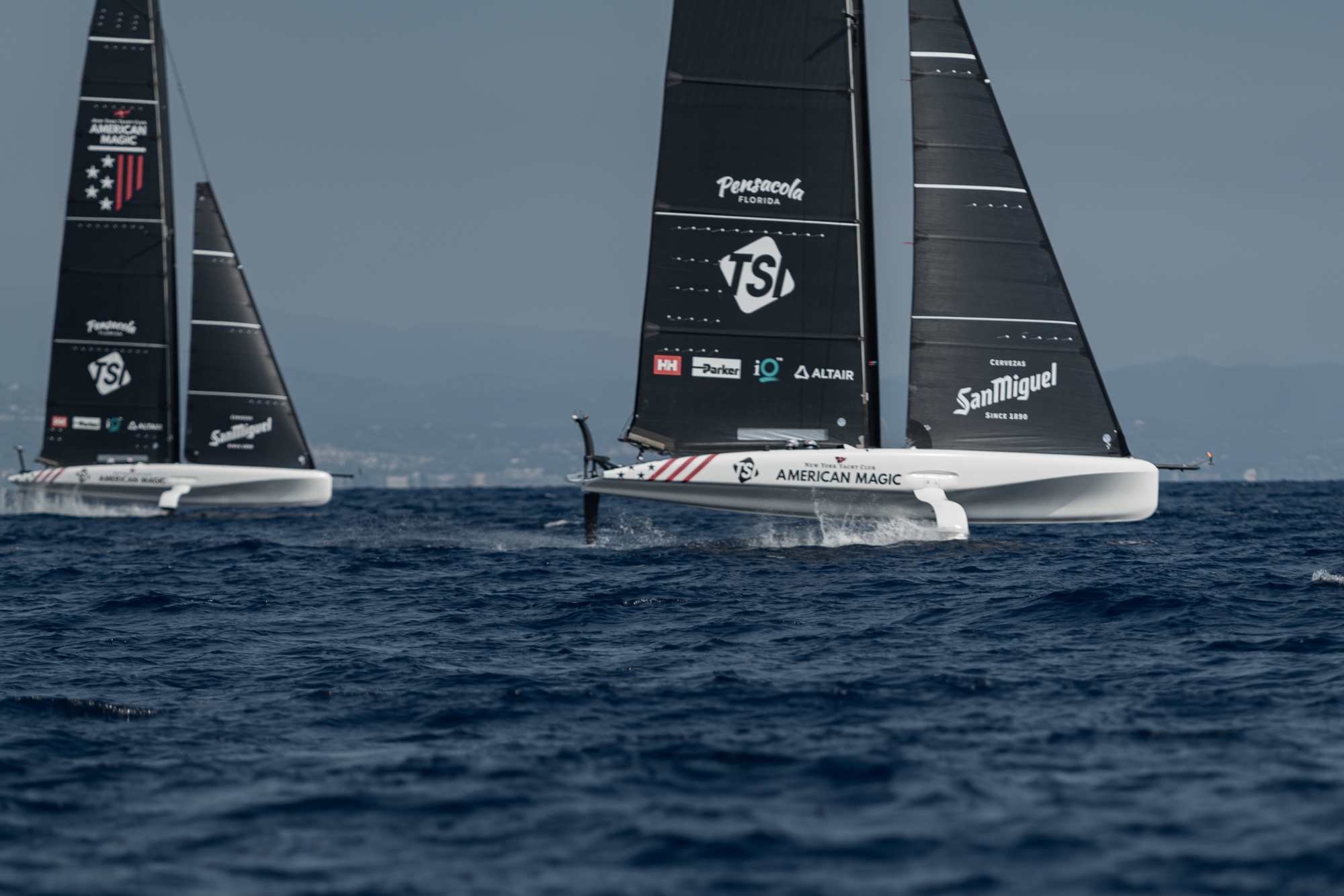
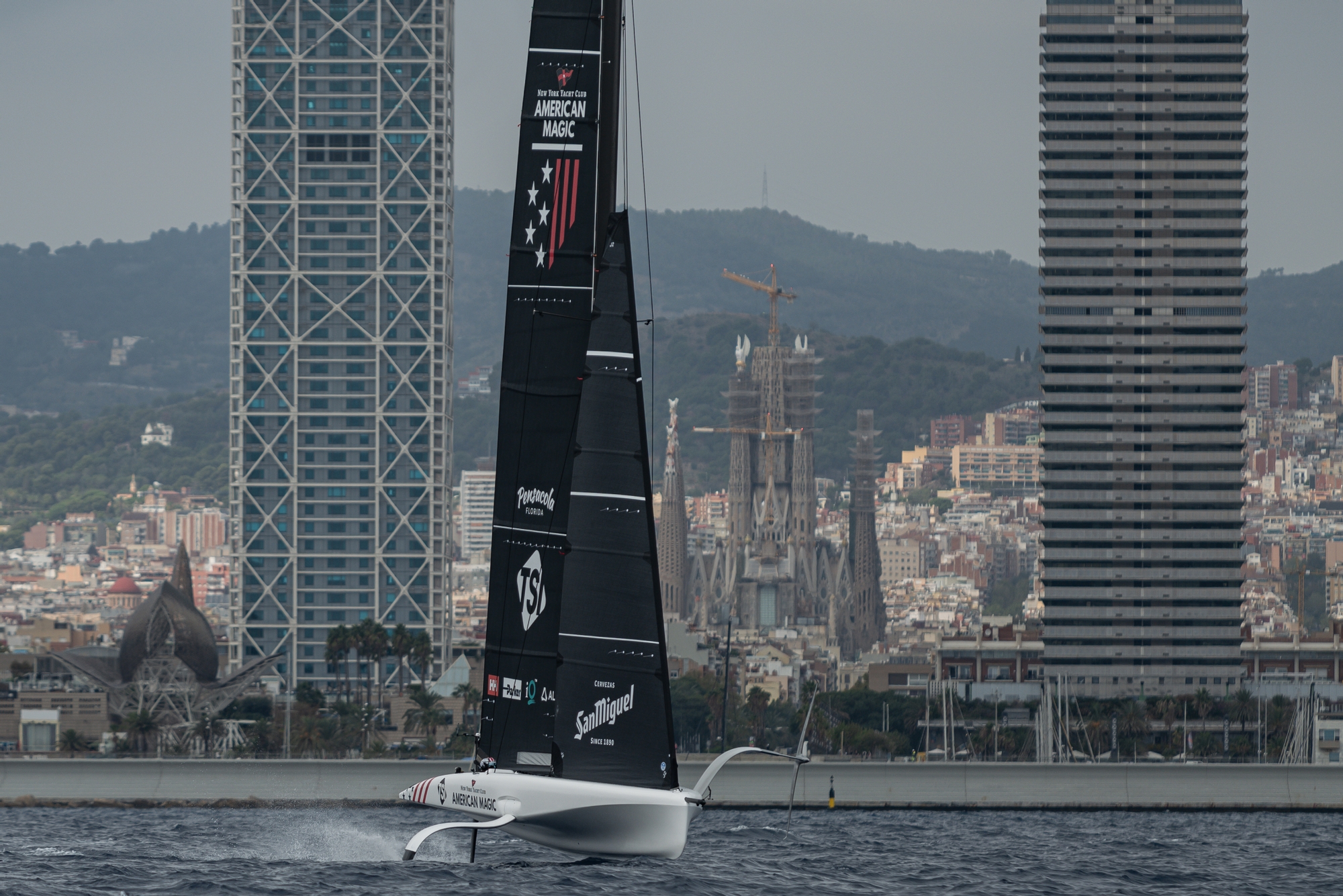
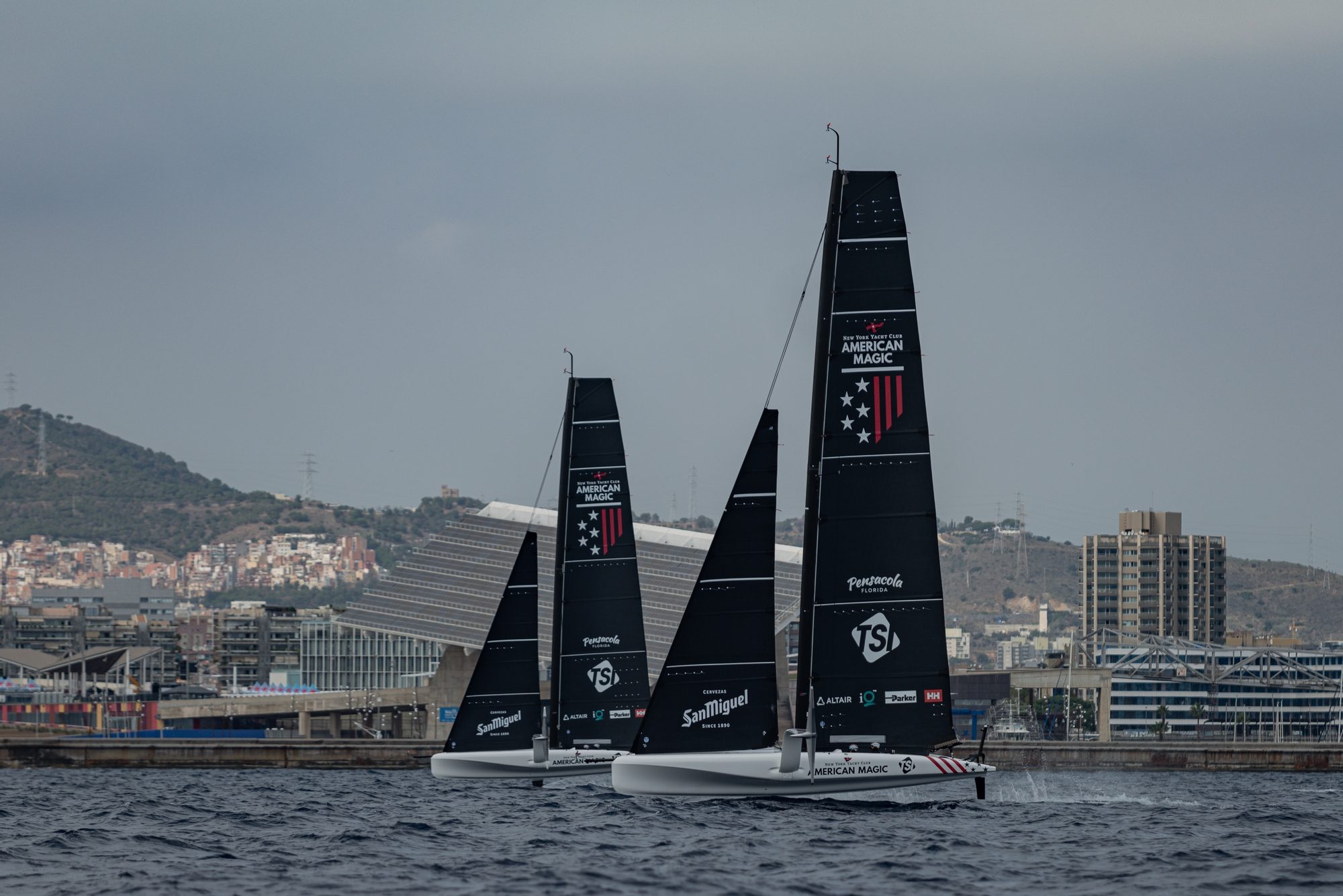
NYYC American Magic continued their foil evaluation programme, lining up both ‘America’ and ‘Magic’ on long runs far offshore and then flying down on the angles back to the Badalona seafront and on to Barcelona. Impressive to watch from the water, the dedication to get meaningful line-ups on perfect symmetry were hampered by the shifting breeze that was brought in on cloud-cover before dispersing as the clouds rolled over Barcelona city itself. The on-water recon team, led by Argentinian Olympic Coach Sebastian Peri Brusa reported: “A weak ENE gradient wind, shifting persistently right in direction and dropping in intensity during the day prevailed. In addition, some clouds came into play making it very patchy and hard for both boats to be sailing in the same breeze to permit comparable performances “without noise.”
Getting a Flight Controllers perspective offers an insight into the trade-off world that American Magic is going through with a variety of foils on two asymmetric, modified, AC40’s. Andrew Campbell was thus the perfect interviewee today, saying: “Each foil will be set for a slightly different targets, every foil has kind of its optimum condition for every band of the wind range so if you just trim the sails the same for all four foils then you're not getting the most out of each foil so we're going through that process and the reality is that every time we tacked today we were in a different breeze condition and so you're trying to make the most out of what you have for every time you get out of a new tack and into a new puff into a new lull and it was a super dynamic day for all the trimmers…you're just you're trying to understand how quickly the acceleration rate happens so certain foils will accelerate differently than others, then you need to go through the range of trim to make things from the fullest trim out of the exit of the manoeuvre to the flattest that you're going to get for that foil, you know you have to make that transition happen smoother on your foil if it's accelerating better.”
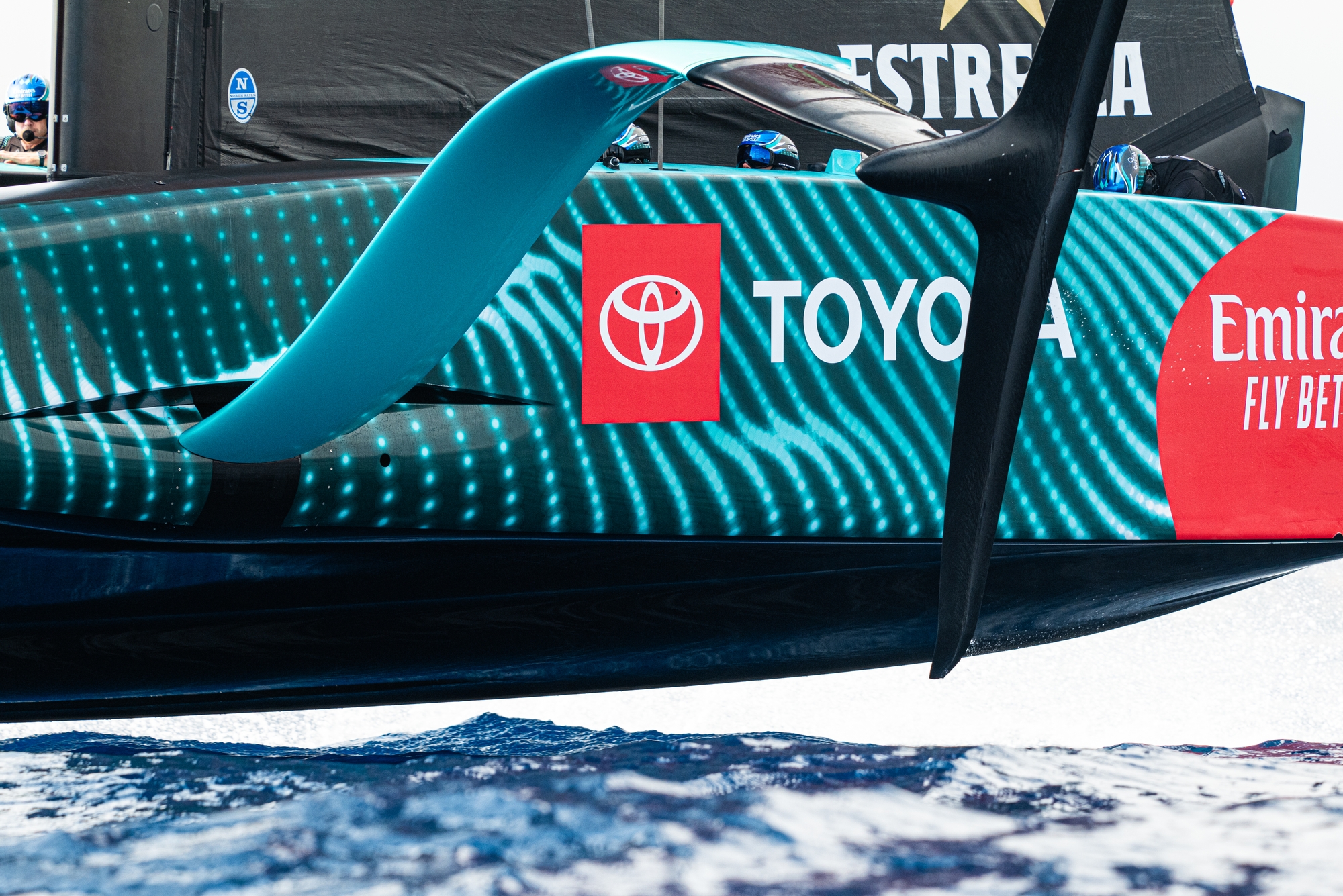
On the face of it, Emirates Team New Zealand looked to have a very standard training day that to the naked eye appeared to be just a technique day. However, look closer and this was a highly technical day of pre-sets definition in what ended up being a relatively wide wind range. No surprise therefore to see Pete Burling jumping out of his pod to take photos at crucial moments and with genius sailmaker Burns Fallow on the boat today, it was clear the programme that the Kiwis were following in their usual devastatingly efficient manner. Hard to see any errors in execution other than one wild exit from a gybe at around 35 knots that kicked up the spray. Other than that, it was ruthless efficiency through the tacks with the super-late board drop on the windward side as they enter and the now-standard over-sheeting of the mainsail track to windward both pre the gybe and on the exit.
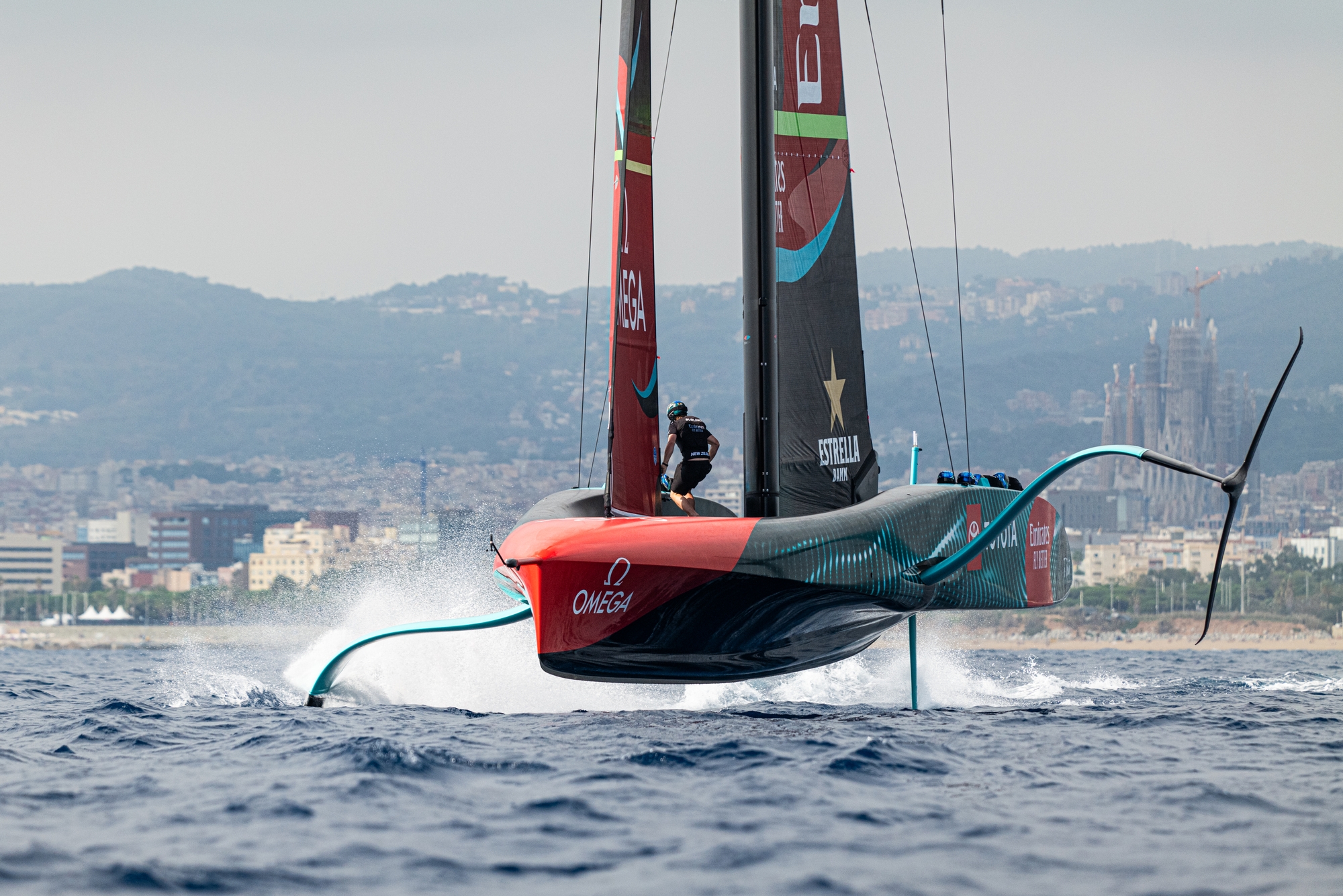
Speaking afterwards, yachting journalist Justin Chisolm spoke with Burns Fallow who offered a glimpse into the sailmaker’s world, saying: “We're nearly a year out from the Cup so trying to learn as much about the venue as we can at this time of the year. It's important for us anytime we can get out on the big boat, it's good learnings for us, it's an old boat but it’s a good old boat.” And speaking specifically about sails and whether we would see anything radical, Burns added: “No I don't think radically different, the rules themselves are in fact more restrictive than they were last time with no code zeros and things like that. I mean there are differences in the boats with new foil arms and the stiffness of the boats coming down and things like that so those are factors which will affect the subtleties of our design and obviously different venue, so you are targeting different sorts of wind ranges due to what we expect, although I've been here for two weeks, and I think you have to expect to have everything.”
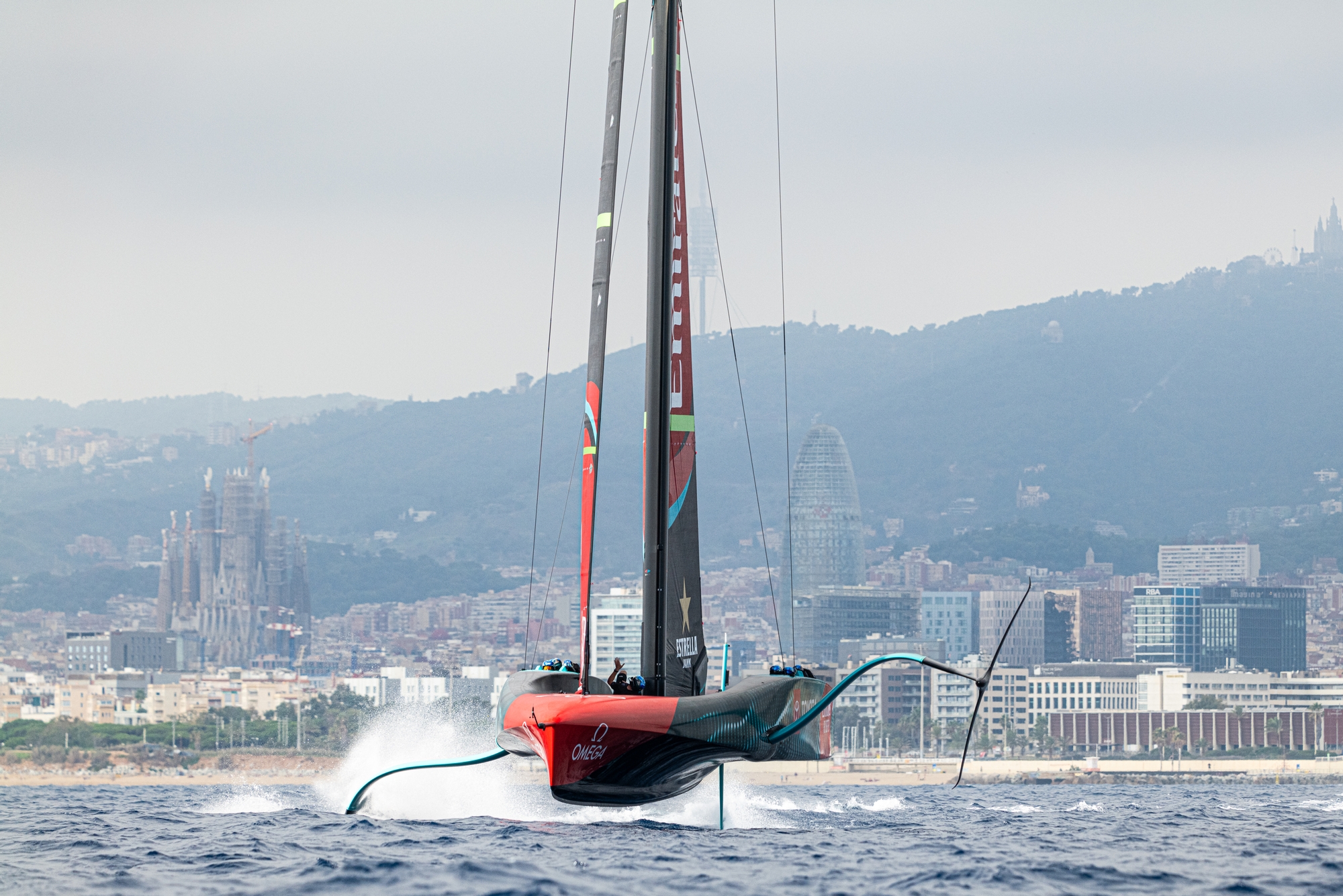
With the team’s AC40 in the background, Burns talked about the key issue of sail control and when asked what we will see on the new boats he countered: “yeah very little actually that's one of the fun things when everyone will launch their new boats is seeing what solutions people have come up with, we saw it in the last Cup cycle with who had booms who had no booms, clew boards whatever, and each team will go down their own path, I mean the boat in the background, the AC40, was obviously something pretty similar to what we had on Te Rehutai during the Cup but it’s up to everyone to decide what's best for this for their own needs.”
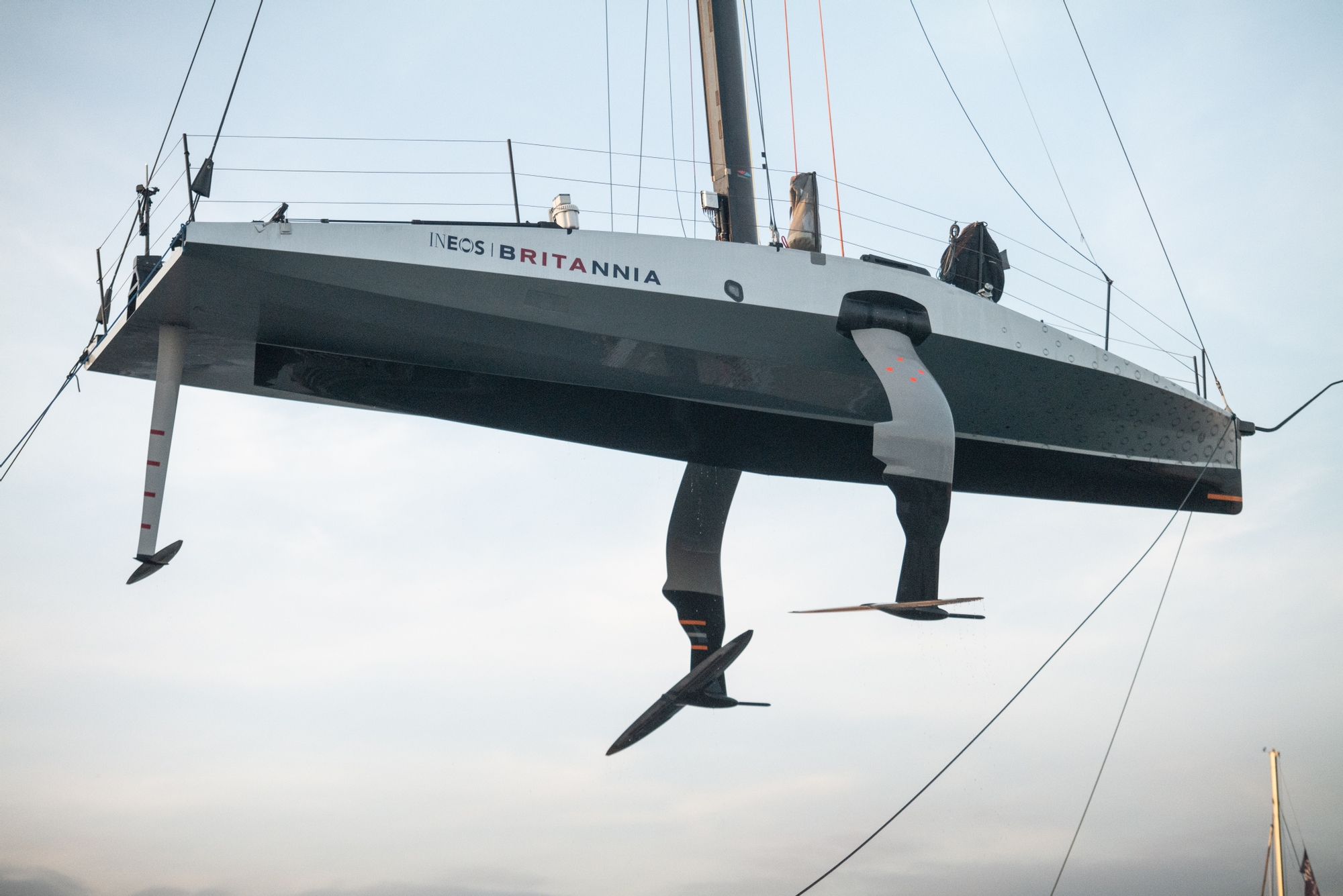
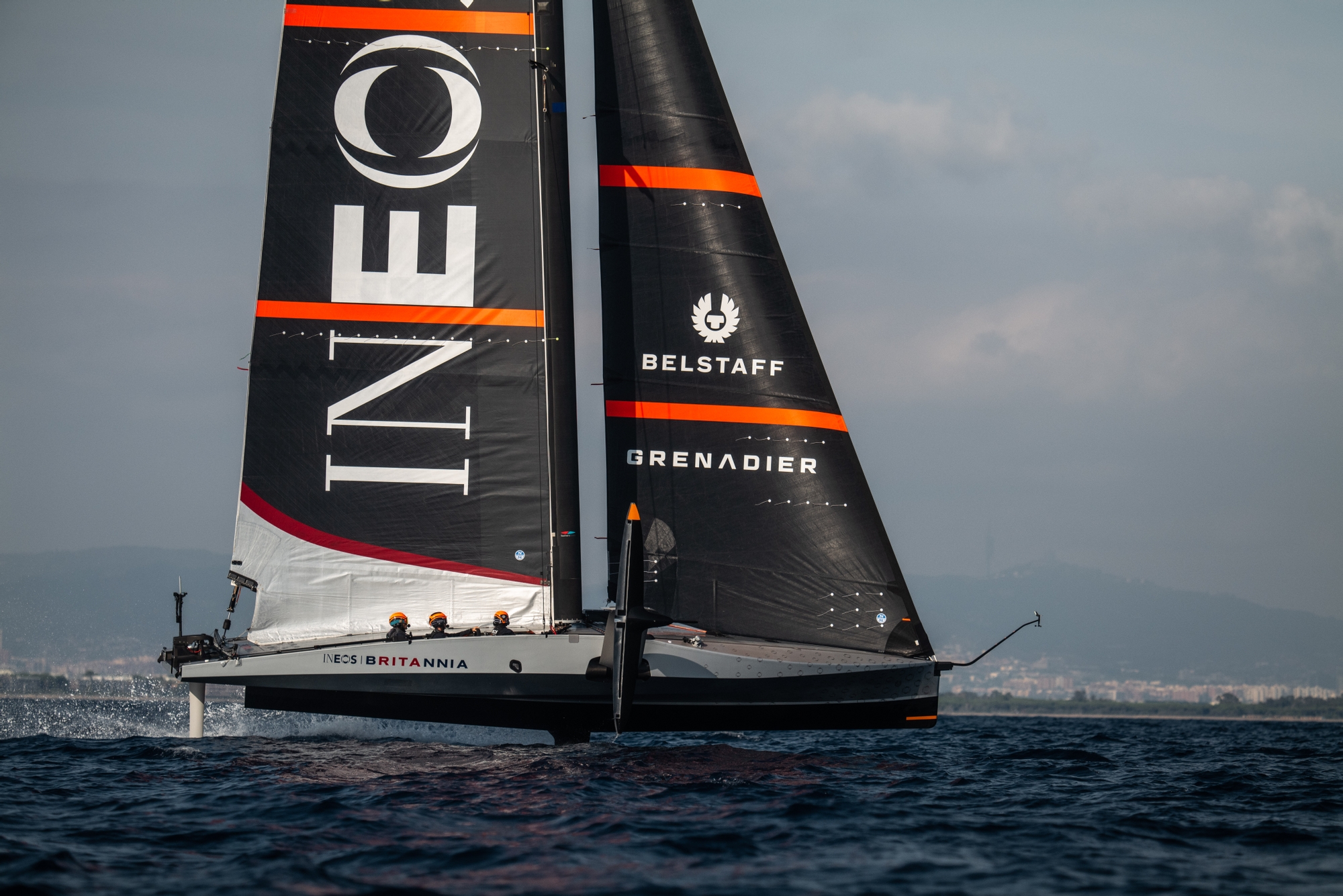
As Te Rehutai made its way back to port mid-afternoon, the welcome sight of INEOS Britannia’s LEQ12 was seen coming out of the Port Vell under sail and on an early set up of their foils. Clearly the team’s focus is moving on from foil validation and it’s all about systems, pre-sets and controls now for this highly technical prototype.
After a period of trying to catch the last of the north easterly that had switched to north westerly proved fruitless, the Challenger of Record headed down south towards the airport to catch the incoming south-westerly and enjoyed a superb session of long, consistent straight-line sailing to work on both the hydro and aero control systems that the team have upgraded and deployed in the recent weeks.
Speaking afterwards, Giles Scott, Head of Sailing offered a review of the day saying: “We decided to switch back to more symmetrical set up for some for some testing that we're doing so yeah we're in a slightly different configuration but yeah we had add a good one with the straight line testing we did…we've been changing a few things with the appendages…we're back to our original setup and our focus isn't on the foils, certainly wasn't today, we had other objectives with some of the systems stuff so we just went out with a nice or almost symmetrical set up…. there's a lot to play within the systems world from all the hydro controls we have and all the aero as well so it's a big project to get into and I'm sure all the all the teams are getting into that now.”
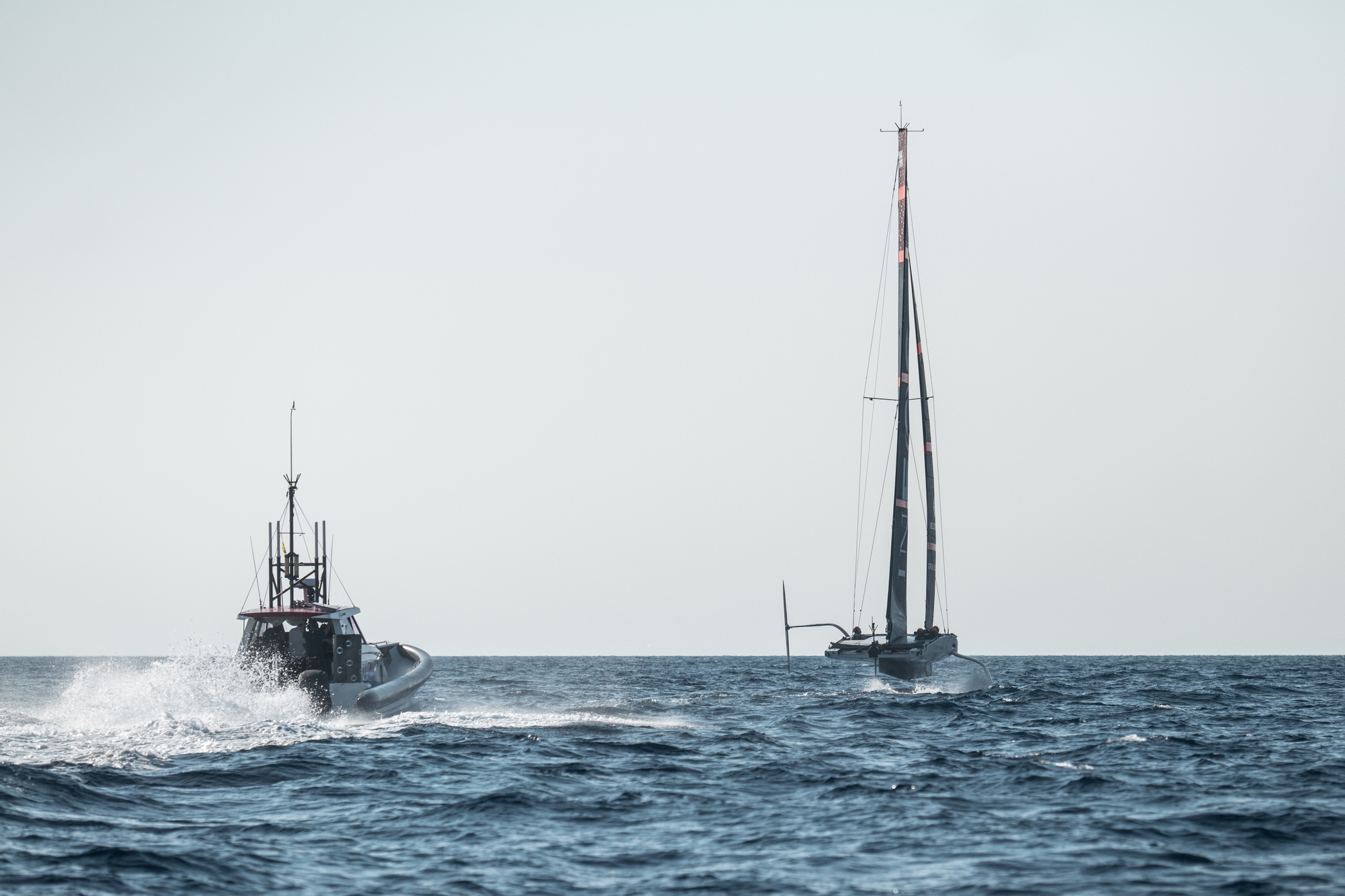
A lengthy 80 nautical miles were clocked up by the team and Giles spoke about the fact that T6 is perhaps coming to the end of its testing life saying: “I'm not sure we've completely defined the final day that will sail T6 externally, but we are getting towards the back end of its lifetime it's been used to get us through a lot of the key design sign offs and on that data collection and validation piece so yeah we’ve still got a lot to do with it but it is towards the end of its useful lifetime.”
The British team have been busy in Barcelona in recent weeks with plenty of AC40 one-design sailing and all eyes on an improved result in Jeddah, Saudi Arabia for the next Preliminary Regatta at the end of November. T6 still very much has a place for the development of what’s been nicknamed RB3 and with a positive session under their belt today, they will be keen to keep pushing with more sessions planned this week. (Magnus Wheatley)
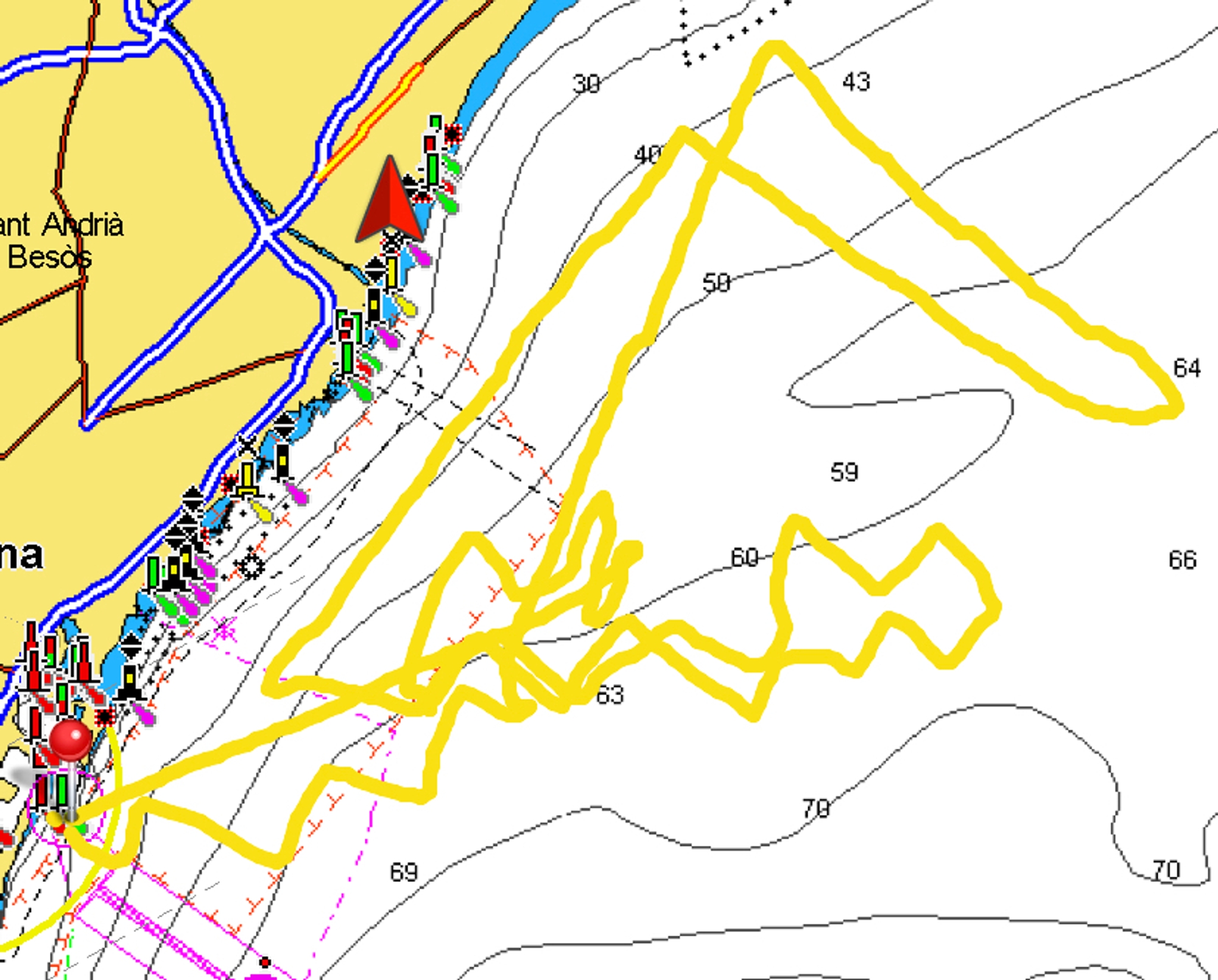
On-Water Recon Unit Report – NYYC American Magic: The team rolled out their AC40s from the shed at 10.00 (Magic) and at 10:34 (America). Both boats on LEQ12 mode, with the same foils’ configuration as yesterday and as last Monday in terms of arms, wings, and flaps.
Magic with the new foil wing and foil flap on the starboard side (FW4 and FF4); and with foil wing #1 and foil flap #1 (FW1 and FF1) on the port side. America was composed with foil wing and flap #3 (FW3 and FF3) on the port side with no skeg; and with foil wing and flap #2 (FW2 and FF2) on the starboard side.
Both boats were craned to the water at 10:30 and 11:07, respectively; and they docked out at 12:10, as planned. The same one-design sails were selected again for both boats. The MN3 for America and the MN2 on Magic. Immediately after coming out from the port, one-design J2s were hoisted at 12:25 approximately.
Today´s conditions were far from being the best ones for testing. A weak ENE gradient wind, shifting persistently right in direction and dropping in intensity during the day prevailed. In addition, some clouds came into play making it very patchy and hard for both boats to be sailing in the same breeze to permit comparable performances “without noise”.
The first part of the day consisted of speed testing. Two long upwind and downwind were carried out. The only reliable conclusion was that on starboard tack on the upwind, America was faster and same angle, on both occasions and when positioned either to windward or to leeward of Magic. On port tack, what can be said is that differences were smaller than the previous days, but nothing conclusive. On the downwind the two boats alternated who was faster/lower, prevailing the one which was closer to the shore taking advantage of a different breeze.
The second part of the training from 13:45 till 14:20 was focused on tacks and gybes. It was extremely hard to be able to get reliable conclusions on manoeuvres not only due to the conditions of the day, but also given the fact that they were sailing on the lower range of their J2s, a small mistake on the trimming or steering had a big impact in performance, making them fall from the foils at times.
At 14:30 the one design J1s came up on both boats to replace the J2s, in the dying breeze.
During these forty-five minutes of the training not much could be achieved as it was tough to get both boats to line up foiling and flying consistently. At 15:15 the breeze died completely and both boats were towed back to the base.
Both boats entered the port and lowered their sails at 15:35, docked at 15:40 and were craned out at 16.06 (Magic) and 16:25 (America) indicating the end of the day. Sebastian Peri Brusa – Recon on NYYC AM
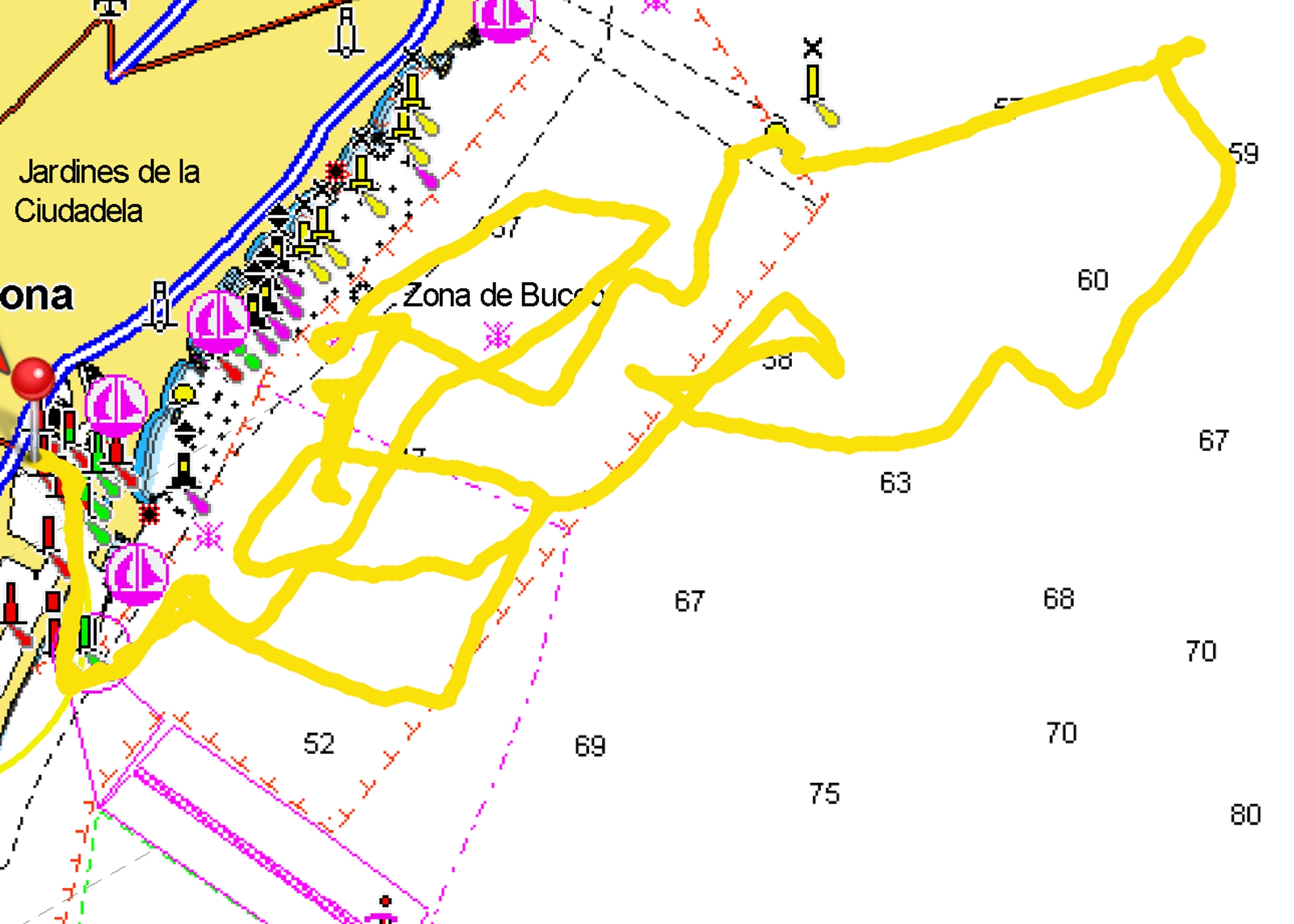
On-Water Recon Unit Report – Emirates Team New Zealand: Emirates Team New Zealand's third consecutive day of sailing aboard their last generation AC75 saw lighter winds than initially forecast with low grey cloud cover preventing the regular southerly wind flow from establishing itself. That left a north easterly (060) breeze of around 10-12 knots at midday which faded to 6-7 knots by the end of the two-and-a-half-hour session.
‘Te Rehutai’ rolled out on time at 1030 and was rigged and launched by 1100 ahead of an on-schedule dock out at 1200. The boat was bow towed out of the harbour at 1215 with sails down but by 1225 the team had hoisted the J3-6 headsail and the M1-3 mainsail.
The boat was quickly airborne as the crew set off on a long upwind run during which they put in 10 tacks. Boat speed upwind was in the mid-30 knot range. Notable once again as in previous days was the precision with which the crew sailed the boat with the bow dipped and so close to skimming the surface of the water.
During a half an hour of free-sailing up and downwind like this, helmsman Peter Burling could be seen taking shots of the headsail. A brief stop at 1300 was followed by another long upwind run with 12 more foiling tacks before stopping at 1330 to rotate the cyclors, and – in response to the wind dropping to 6-7 knots – change headsail to the J2-6. More upwind / downwind sailing followed with during the final downwind run the crew putting in 12 gybes - often with two in quick succession just 20 - 30 seconds apart. With the breeze fading considerably at this bottom end of the training area, time was called at 1425.
Sails were down by 1435 and the boat docked in at 1450 where the team's one design AC40 was waiting to be sailed in a separate second session. (No recon as the boat was in one design mode.)
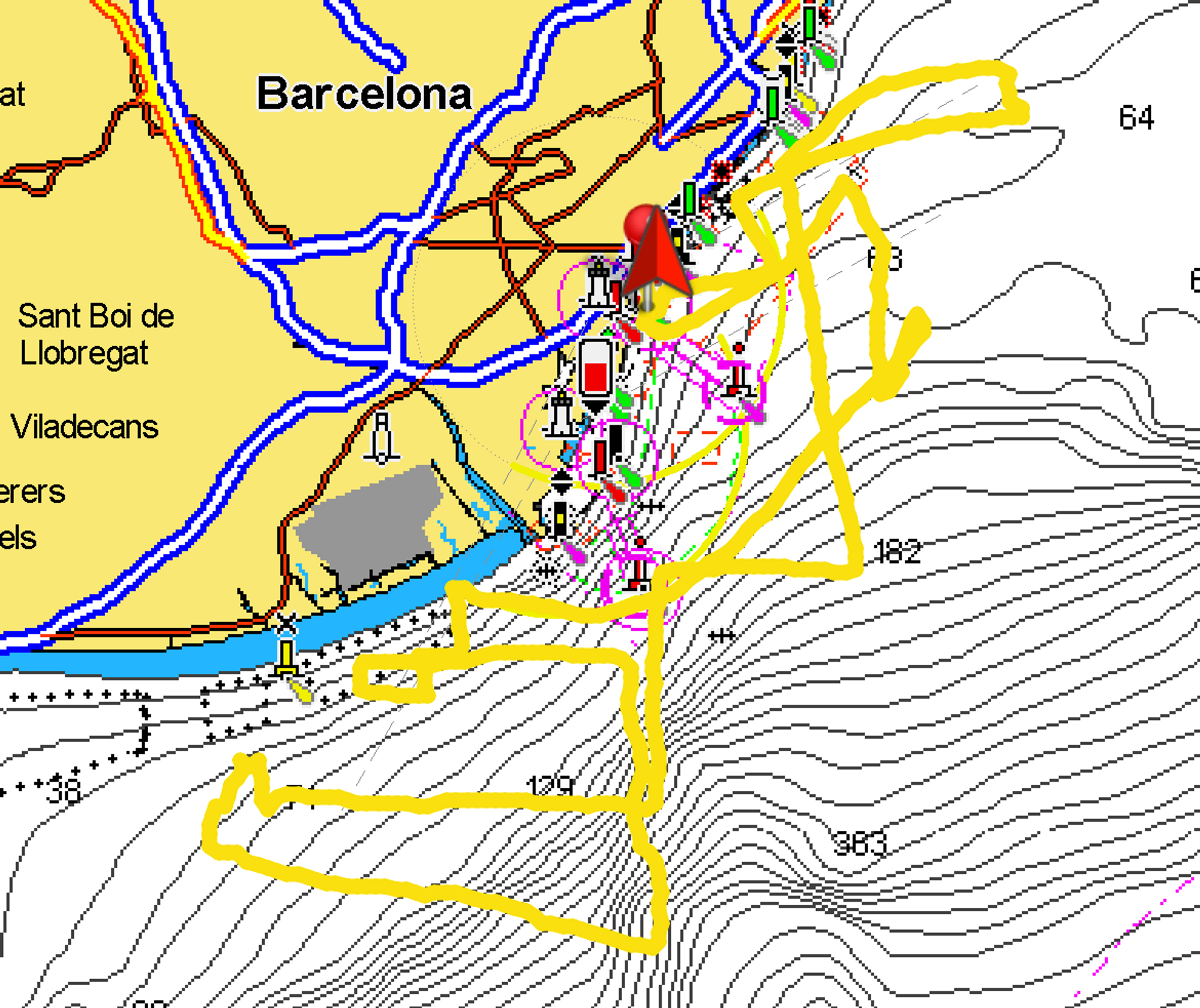
On Water Recon Unit Report – INEOS Britannia: INEOS Britannia rolled out their T6 test boat at 10:00. Notably, the starboard side's banana foil was removed, with both the original elliptical foils in place. Though seemingly identical, ‘subtle differences’ have been confirmed between the two foils in a past interview. The foil arms do not seem to be updated in form, however they have been re-painted. The rudder has been reverted back to a flat elliptical elevator. By 10:50, the mast was stepped, and the yacht was craned in.
The plan for the day was systems testing, as the team are focusing on aero and hydro control systems. Visible pre-sailing checks and systems tests included mast rotation, forestay and jib sheet system. Three batteries were carried onto the foredeck, replacing previous ones. The M1-2 mainsail skins and J2-2 jib were prepared on deck ahead of 13:30 dock-out (postponed from 12:30). Dylan Fletcher helmed on starboard, with Leigh McMillan trimming and Ben Cornish in the 5th sailor seat. Giles Scott helmed on port, with Luke Parkinson trimming in front.
The yacht was released from alongside the chase boat after hoisting the mainsail and jib under the port entrance's breakwater. A brief pause in saw the sailors readjust tension by dropping the jib a few meters. The yacht was then towed North, initiating a tow start 2NM offshore from the Forum.
Stint 1 commenced at 14:20 post-release of the towline, however the yacht fell off the foils following a tack. After half an hour sailing further offshore in displacement mode, another tow start was attempted but the lack of wind prevented the team from maintaining flight.
Ahead of Stint 2, the yacht was towed south toward the airport's sailing area, where the team found wind and started their session with a short upwind of four tacks. The yacht bore away and gybed onto a long downwind leg on starboard, followed by an extended upwind leg on the same side. The 35-minute sail ended with a technician boarding and investigating below deck, while sailors were seen looking up the mast.
Stint 3 saw a long upwind on port, followed by a brief downwind involving four gybes. The yacht was stopped through a two-board round-up, and a battery exchange occurred alongside the chase boat.
In Stint 4, the team sailed a long downwind towards Montgat of five gybes, 17NM as the crow flies.
During Stint 5, the team initiated an upwind on port tack, decelerating to displacement mode briefly before resuming foiling and continuing upwind to the port entrance, performing four fully foiling tacks.
The sails were dropped at the port entrance at 18:25, and the yacht was towed back to base, docking in at 18:40. The Recon Unit covered 80 Nautical Miles observing the team’s five-hour session on the water. 19 manoeuvres were performed, of which 75% were fully foiling.